

Boost Real Estate Success with Fast Follow-Up
Follow-Up Speed Still Beats Everything Else in Real Estate
In every market cycle, new tools, portals, and lead sources appear. Yet one variable still separates the agents who close consistently from those who just stay busy—real estate follow-up speed. If you want to convert leads in real estate at a higher level, your first response time and your ability to stay fast across the entire follow-up sequence matter more than almost anything else.
Why follow-up speed still wins in real estate
Responding within 1–5 minutes can make you up to 21× more likely to qualify a lead, with conversions up to 391% higher than slow responders.
The average industry response time is still measured in hours, not minutes—meaning speed is a huge, underused competitive edge.
Fast follow-up systems combine clear rules, automation, and channels like WhatsApp, SMS, and CRM tasks.
Agents who persist with 6–10 touches convert up to 300% more leads than those who stop after one or two attempts.
Mindset is non‑negotiable—treat every new lead as a live conversation that must be answered now, not later.
Why Follow-Up Speed Is Still the Most Powerful Conversion Lever
Real estate technology has evolved fast—AI routing, global portals, advanced CRMs. But the human reality behind the screen has not changed: buyers and sellers reach out when their intent is hot. If you are the first person to give them clarity, confidence, and next steps, you win more business, regardless of how crowded your market is.
Recent data confirms what top agents already know. In early studies, responding to an online lead within one minute produced up to 391% higher conversions compared with slower responses. Agents who answered within five minutes were 21× more likely to qualify a lead than those who waited 30 minutes or more. A response within one hour was 60× more likely to connect than waiting 24 hours—after a day, your chances collapse.
Even in 2026, the industry average response time is still painfully slow—measured at over 15 hours in some surveys, and around 39 hours in others. At the same time, AI-enabled systems now answer in 8–25 seconds. This gap between what is possible and what most agents do is your opportunity. If you commit to a fast follow-up strategy, you immediately move into the top tier of performers in your market.
Think about your own behavior as a consumer. When you inquire about a property abroad, a mortgage, or a relocation question, you rarely wait patiently for the fifth agent to call you back. You go with whoever responds quickly, communicates clearly, and makes the next step easy. Your leads behave exactly the same way.
The Data Behind the First-Responder Advantage
The “first response real estate” advantage is not a slogan—it is measurable. Multiple studies across hundreds of thousands of leads show the same pattern: the faster you respond, the higher your connection and conversion rates.
Key numbers you cannot ignore:
Average industry response time is around 917 minutes—about 15 hours. In some mid‑2026 datasets, the average is closer to 39 hours, still far too slow.
Responding within five minutes makes you 21× more likely to qualify a lead than responding after 30 minutes.
Responding in under a minute can drive nearly 4× higher conversions.
AI-enabled systems that answer in under 30 seconds dramatically outperform human-only workflows.
Despite this, around 68% of inbound leads never receive any response at all.
Now connect those numbers to your daily reality. If most agents take hours—or never respond—and you reply in 60 seconds or less, you are not just slightly better. You are in a different league. You will often be the only agent the client remembers.
Conversion data tells the same story. While portal leads typically convert at 0.4–1.2%, agents using structured systems with fast response and consistent nurturing see conversion rates of 5–8% and higher. That is not magic; it is math plus discipline.
Close-up of a large wall clock overlaid on a modern apartment exterior, faint motion blur...
Speed Is Not Just the First Reply — It’s the Whole Follow-Up Sequence
Speed-to-lead is the opening move, but it is not the entire game. Most agents fail not only because they respond slowly, but because they give up almost immediately.
On average, real estate professionals make only 1.3 follow-up attempts before stopping. Nearly half never follow up at all. Yet, across large datasets, about 95% of conversions happen after the sixth contact attempt. Customers say “no,” “not yet,” or go silent several times before they finally say “yes”—and agents who stay present through that cycle capture the business.
Leads that receive six or more touches can convert at rates up to 70% higher than those with fewer attempts. That means your speed must be paired with persistence. The most profitable agents are both fast and relentless: they respond in minutes, then follow up systematically over days, weeks, and sometimes months.
This is where a consistent follow-up being essential in real estate becomes obvious. Fast first contact opens the door; consistent, structured follow-up keeps you in the room until the client is ready to move.
How to Build a Fast Follow-Up System That Actually Works
1. Decide Your Non-Negotiable Response Standard
Start by setting a clear rule: for example, “Every new lead gets a response within 60 seconds, 24/7,” or “Within five minutes during business hours, and within 15 minutes outside.” The exact number matters less than the fact that it is specific, measurable, and non‑negotiable.
Once you set this standard, design everything else—tools, notifications, delegation—around making it real. If you are working across time zones with international buyers, a 24/7 standard may be your main competitive weapon.
2. Centralize All Leads in One Place
Slow follow-up often happens because leads are scattered—portal inboxes, WhatsApp chats, email, social DMs. You cannot respond fast if you are hunting for messages.
Use a CRM or lead management tool that pulls leads from all major sources into a single dashboard. Set up instant notifications—push, SMS, or desktop—so every inquiry triggers an alert. The moment a lead arrives, you should know who they are, where they came from, and what they asked for.
3. Pre-Write Fast Response Templates
Speed does not mean sounding robotic or careless. It means removing friction. Pre‑write short, professional templates for your first response via SMS, WhatsApp, and email. For example:
“Hi [Name], thanks for your interest in [Property/Area]. I’m available now to answer questions or send a quick video walkthrough. What’s the best way to reach you—WhatsApp or a quick call?”
Store these in your CRM, phone, or WhatsApp Business quick replies. The goal is to reduce your decision time to almost zero—one tap, personalized name and property, and send.
4. Map a Follow-Up Cadence — Then Automate the Routine
Design a follow-up schedule that covers at least 10 touches over 30–90 days. For example:
Day 0: Immediate response (SMS or WhatsApp) + email with basic info.
Day 1: Call attempt + short follow-up message.
Day 3: Market update or property suggestion.
Day 7: Check‑in message with a question about their timeline.
Days 14–30: Weekly value messages—videos, guides, or new listings.
Days 30–90: Bi‑weekly or monthly check‑ins, especially for international buyers with longer decision cycles.
Use your CRM to automate reminders and, where appropriate, automated messages. Automation should not replace you—it should make sure you never forget the next step.
This is exactly where building a structured follow-up system becomes the difference between “ghosted” and “closed.” International clients often move slowly and across time zones; your system must be patient, consistent, and visible.
WhatsApp and Automation: Turning Speed into a Daily Habit
For international real estate agents, WhatsApp is no longer optional. It is the default communication tool for buyers and investors across Europe, Latin America, the Middle East, and much of Asia. If you want a fast follow-up strategy that feels natural to your clients, WhatsApp should sit at the center.
Why WhatsApp Beats Email for First Response
Email open rates in real estate hover around 20%. SMS and messaging apps like WhatsApp, by contrast, see open rates close to 98%. When a new lead comes in, sending a WhatsApp message or SMS within 60 seconds almost guarantees it will be seen—right when the client is still actively thinking about their inquiry.
WhatsApp also supports voice notes, quick photos, and short videos. That means your first response can be more than words. You can send a 20‑second voice message introducing yourself, or a quick video standing in front of the property or your office. This level of speed and personalization is almost impossible to ignore.
Using Automation Without Losing the Human Touch
Automation is your ally, not your replacement. The goal is simple: no lead should wait more than a few seconds for a basic acknowledgment, even if you are in a meeting or on a viewing.
With WhatsApp Business, CRMs, and simple AI tools, you can:
Trigger an instant WhatsApp greeting the moment a lead submits a form.
Send automated answers to common questions—availability, price range, location details.
Route hot leads to you or your team via notifications and assignment rules.
Schedule follow-up reminders so no conversation goes cold by accident.
For deeper strategies, explore resources on using WhatsApp for instant lead response. The combination of automation plus personal follow-up is what turns a simple tool into a revenue engine.
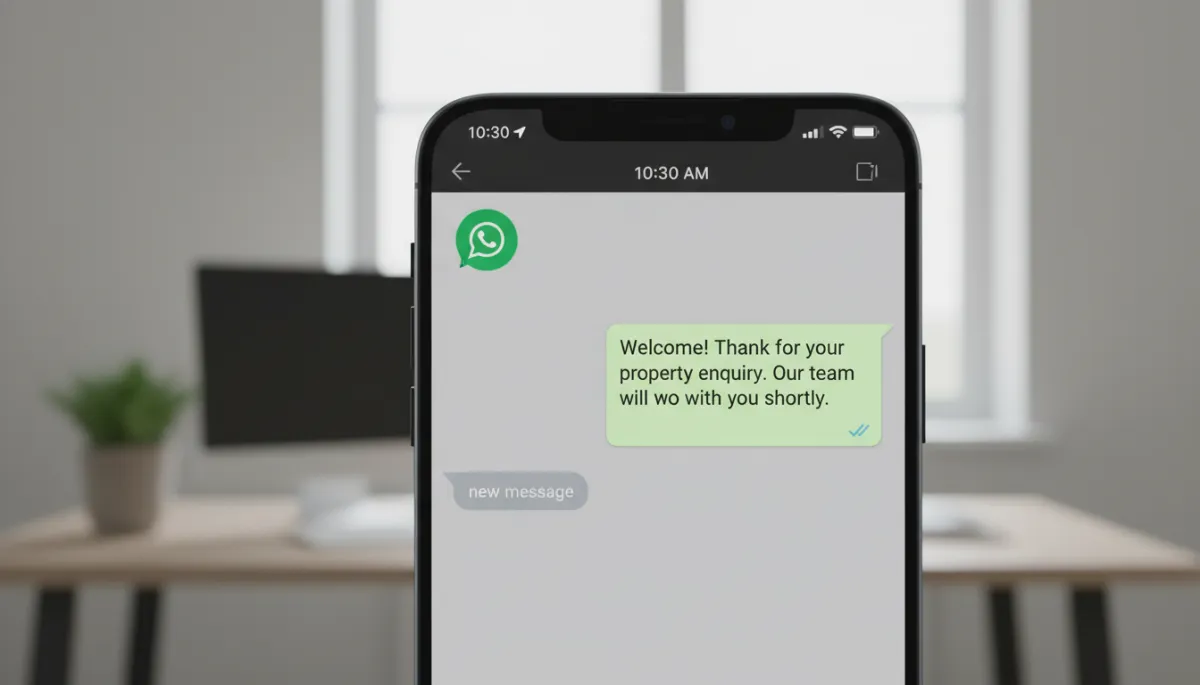
Close-up of a smartphone screen showing a WhatsApp chat, automated welcome message to a new...
One practical rule: let automation say “hello” and set expectations, then you follow quickly with a human, personalized message. This keeps your speed advantage while reinforcing trust.
Mindset: Treat Every Lead Like a Live Conversation
Tools and templates will not save an agent with a casual mindset. The high performers—across markets and price points—share a simple belief: a new lead is not “an email” or “a form.” It is a live conversation that just started, and it is your job to answer it immediately.
Adopting a speed mindset means:
Reorganizing your day around response windows—blocking time for prospecting is important, but you must also protect your ability to respond fast.
Training your team or assistants to treat new leads as urgent, not as admin tasks that can wait.
Accepting that speed is a discipline. You will sometimes respond from the car, the airport, or between appointments. That is the price of winning more business.
For international agents, this mindset extends across time zones. A buyer in Dubai, London, São Paulo, or Singapore may contact you outside your local business hours. You do not need to be awake 24/7—but your system should be. An instant automated reply, followed by a personal message as soon as you are available, is often enough to keep you in pole position.
Process: Turning Speed into a Repeatable Advantage
Mindset gives you the “why.” Process turns it into a reliable “how.” To make real estate follow-up speed your competitive edge, document and refine your process.
Key Elements of a High-Speed Follow-Up Process
Lead routing rules: Decide who gets which leads—by language, budget, source, or location—and set this up in your CRM.
Notification hierarchy: Use multiple channels—app notifications, SMS, email alerts—so you never miss a new inquiry.
Standard operating procedures (SOPs): Write clear steps for your first five minutes, first day, and first week of follow-up.
Templates and scripts: Maintain a library of tested messages for different scenarios—buyers, sellers, investors, tenants, and international relocations.
Measurement: Track your average response time, number of touches per lead, and conversion rate by source. Review weekly or monthly and adjust.
When you treat your follow-up like a process, not a mood, your results stabilize—and then scale. You move from “hoping” for good months to consistently converting leads in real estate at a higher level.
Bringing It All Together: Speed, Persistence, and Trust
Follow-up speed is not a trend. It is a permanent law of real estate behavior. In 2026, with AI, global portals, and hyper‑competitive markets, the agents who win are those who combine three things:
Speed: They respond to new leads in under five minutes—ideally under one minute—using tools like WhatsApp, SMS, and automated replies.
Persistence: They design and follow a multi‑touch sequence, knowing that most conversions happen after the sixth contact.
Trust: They use every fast interaction to add value—answering questions, sending relevant information, and demonstrating expertise.
Most of your competitors will not do this. They will stay slow, inconsistent, and reactive. That is good news for you. If you commit today to building a fast follow-up strategy—anchored in data, powered by automation, and driven by a professional mindset—you will stand out in any market, in any country, at any price point.
Speed still beats everything else. Make it your signature.

Smiling couple seated at a modern desk signing property purchase documents with a real estate...
FAQ: Fast Follow-Up in Real Estate
1. How fast should I respond to a new real estate lead?
The data is clear—within five minutes should be your minimum standard, and under one minute is ideal. Agents who respond in that window are up to 21× more likely to qualify leads and can see conversions nearly four times higher than slower responders. In practical terms, aim for an immediate WhatsApp or SMS message, followed by a call or email.
2. What if I cannot be available 24/7?
You do not need to be personally online all the time, but your system must be. Use automation to send an instant acknowledgment—via WhatsApp, SMS, or email—then follow up personally as soon as you are available. For teams, implement round‑robin or time‑zone based routing so someone is always on duty for hot leads.
3. How many follow-up attempts are enough?
Most agents stop after one or two attempts, but research shows that around 95% of conversions happen after the sixth contact. A good benchmark is at least 10 touches over 30–90 days, mixing calls, messages, and emails. If a lead clearly says “no,” respect that. Otherwise, assume “no reply” means “not yet,” and keep adding value.
4. Is WhatsApp really better than email for international buyers?
Yes. International buyers often live on WhatsApp—it is where they talk to family, colleagues, and other agents. Messages are opened and read far more often than email, and the ability to send voice notes, quick photos, and videos makes the interaction feel personal and immediate. Email is still useful for documents and longer updates, but for speed and engagement, WhatsApp usually wins.
5. How do I start improving my follow-up speed this week?
First, set a clear response-time rule for yourself. Second, centralize your leads into one CRM or inbox and turn on instant notifications. Third, write three to five short response templates for WhatsApp, SMS, and email. Finally, map a simple 10‑touch follow-up sequence and put it into your CRM as tasks or automations. Start small, track your numbers, and refine from there—your conversion rate will follow your discipline.


